
The Department of Mathematics at Politecnico di Milano offers, as part of its MSc in Mathematical Engineering, a specialized track in Quantum Engineering, which is suited for master students interested in the research topics of the FoQuS Lab.
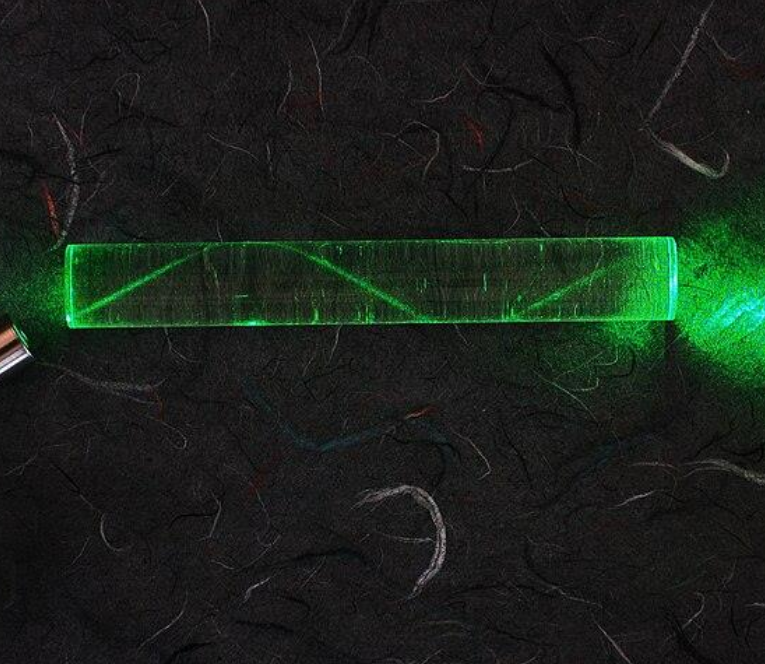
Total internal reflection of laser light in a multimode optical fibre
(Timwether, CC BY-SA 3.0, via Wikimedia Commons)
The development of the foundational principles of quantum mechanics in the early 1920s represents one of the greatest scientific revolutions of the last century. Nowadays quantum mechanics already plays a crucial role in most branches of engineering, just to name a few important examples: the quantum theory of atoms is fundamental to nuclear engineering, laser technology and nuclear magnetic resonance, the theoretical explanations of semiconductors paved the way to the developing of transistors, which are the building blocks of most electronic devices, as well as light emitting diodes (LED), which transformed the field of displays and modern illumination. These are the outcomes of what is nowadays called the “first quantum revolution“.
The year 2025 marks the 100th anniversary of the first seminal papers on quantum mechanics and has been declared by UNESCO the International Year of Quantum Science and Technology. Many institutions, laboratories and global companies firmly believe that we are now on the verge of a “second quantum revolution“, in which a careful control of quantum mechanical effects, such as superposition and entanglements, will allow to design and produce new technological devices that will change our world in the same ways as computers, smartphone and the World Wide Web changed our lives in the past thirty years.
In this scenario, there is an increasing need of new professional figures that have a solid knowledge of the mathematics of quantum mechanics together with the the strong analytical and critical thinking skills of a mathematical engineer: that is why the Department of Mathematics established the Major in Quantum Engineering for the MSc in Mathematical Engineering.
The field of Quantum Engineering is highly dynamical and it is expanding at an accelerating pace each year. The students enrolled in the Quantum Engineering Major will acquire a strong theoretical background in quantum mechanics and its mathematics, as well as in its principal quantum engineering applications. Such a solid background will allow them to quickly adapt to the present and future requirements of companies working on quantum technologies. Nowadays, Quantum Engineering can be divided in three principal subfields:
- Quantum Communication: The goal of quantum communication is the reliable and secure transmission of quantum and classical information through a communication channel. The developing and implementation of quantum cryptographical codes and the harnessing of quantum teleportation are the principal focus of quantum communications.
- Quantum Sensing: The aim of quantum sensing is to create very accurate quantum sensors which can outperform any classical analogue and provide extremely precise measurements. Notable examples are atomic clocks, superconducting quantum interference devices, and nuclear magnetic resonance instruments. A special application of quantum sensors is to the field of quantum metrology, i.e., making very accurate measurements of physical parameters (e.g., physical fundamental constants), exploiting the features of quantum systems.
- Quantum Computing: The goal of quantum computing is to exploit quantum systems to perform computations. The key idea is to develop a computational devices that is based on qubits (quantum bits) instead of classical bits. Theoretically, quantum computers could solve problems that are beyond the capabilities of classical computers. The realization of a scalable and reliable quantum computers is the holy grail of quantum engineering. Fundamental steps to reach such goal are the design and developing of quantum memories and of quantum algorithms for quantum error corrections. Furthermore, the development of quantum communication and quantum sensing are fundamental for the the physical implementation of quantum computers.
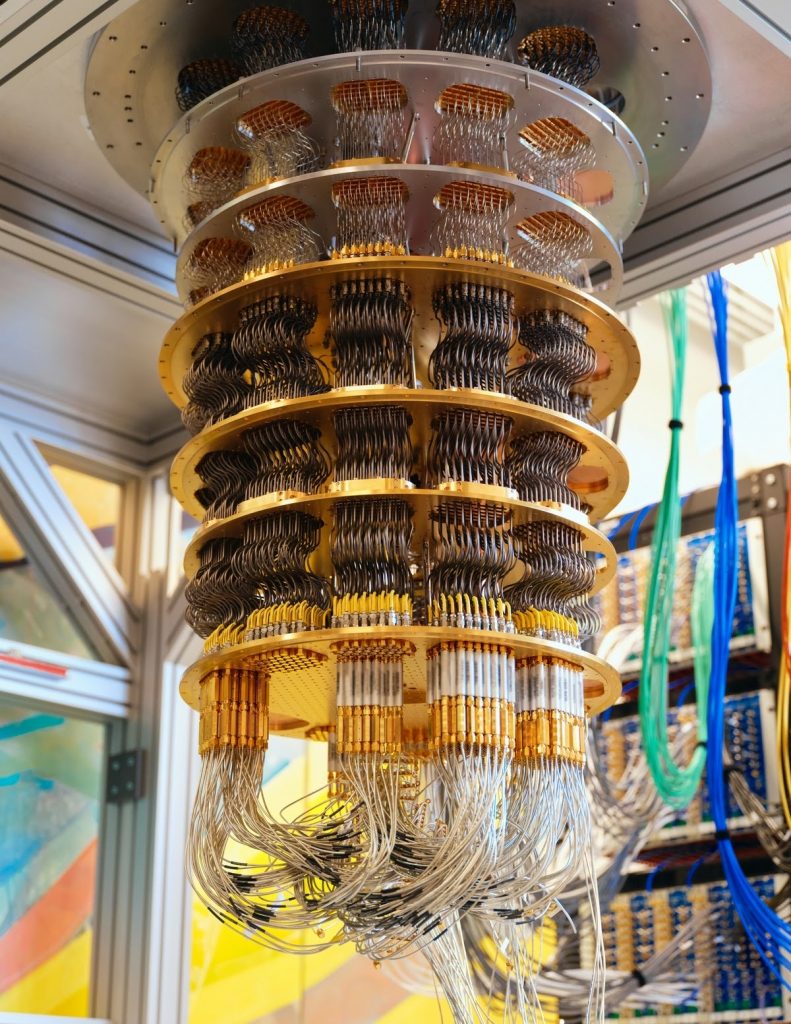
Courses of the Major in Quantum Engineering
The program of the Major in Quantum Engineering is available on the official Polimi Programme database. Further information about the MSc Programme in Mathematical Engineering is available on the official website.
For specific inquiries about the Major on Quantum Engineering you can contact prof. Michele Correggi.
First Year
| Code | SSD | Course | Sem. | CFU |
|---|---|---|---|---|
| 095958 | MAT/05 | REAL AND FUNCTIONAL ANALYSIS | 1 | 8 |
| 052496 | ING-INF/05 | ALGORITHMS AND PARALLEL COMPUTING | 1 | 10 |
| 052656 | FIS/03 | HIGH INTENSITY LASERS FOR NUCLEAR AND PHYSICAL APPLICATIONS I | 1 | 5 |
| 062497 | FIS/01 | SOLID STATE PHYSICS | 1 | 10 |
| 062010 | MAT/02 | GROUP THEORY | 2 | 5 |
| 064474 | MAT/07 | OPERATOR THEORY | 2 | 5 |
| 061970 | MAT/07 | METHODS AND MODELS FOR STATISTICAL MECHANICS | 2 | 5 |
| — | — | Courses from Group ING | — | 10 |
| — | — | Course from Group QPHYS or from Group MTM | — | 10 |
The complete list of the Courses in the ING, POLI and MTM groups, together with more detailed information on each course, can be found on the Polimi Programme database.
Second year
| Code | SSD | Course | Sem. | CFU |
|---|---|---|---|---|
| 063221 | MAT/07 | MATHEMATICS OF QUANTUM MECHANICS | 1 | 10 |
| — | — | Courses from Group QPHYS | — | 10 |
| — | — | Courses from Group ING | — | 10 |
| — | — | Courses to be chosen from the combined list of Group POLI, Group ING, Group MTM and Group PHYS | — | 15 |
| 097690 | — | Final Work | 1 | 12 |
Group QPHYS
| Code | SSD | Course | Sem. | CFU |
|---|---|---|---|---|
| 059497 | FIS/01 | MAGNETISM AND SUPERCONDUCTIVITY | 1 | 5 |
| 096037 | FIS/01 | PHYSICS OF ULTRAFAST PROCESSES | 1 | 5 |
| 062011 | FIS/03 | SEMICONDUCTOR PHOTONICS | 1 | 5 |
| 057885 | FIS/03 | SEMICONDUCTOR QUBITS | 1 | 5 |
| 054863 | FIS/01 | ATOM OPTICS AND QUANTUM TECHNOLOGIES | 2 | 5 |
| 054862 | FIS/01 | QUANTUM OPTICS AND INFORMATION | 2 | 5 |
| 059508 | FIS/01 | RELATIVITY | 2 | 5 |
| 062053 | FIS/01 | SYMMETRY APPLICATIONS IN CLASSICAL AND QUANTUM PHYSICS | 2 | 5 |